Home

  • What is The Slow Run?

    It’s that run that you do although you stayed up late last night.

    It’s that run that you do even though you drank a tad too much the day before.

    It’s that run that is not gonna get you a place on the podium.

    It’s that run that you do for fun.

    It’s that run where you can enjoy the scenery.

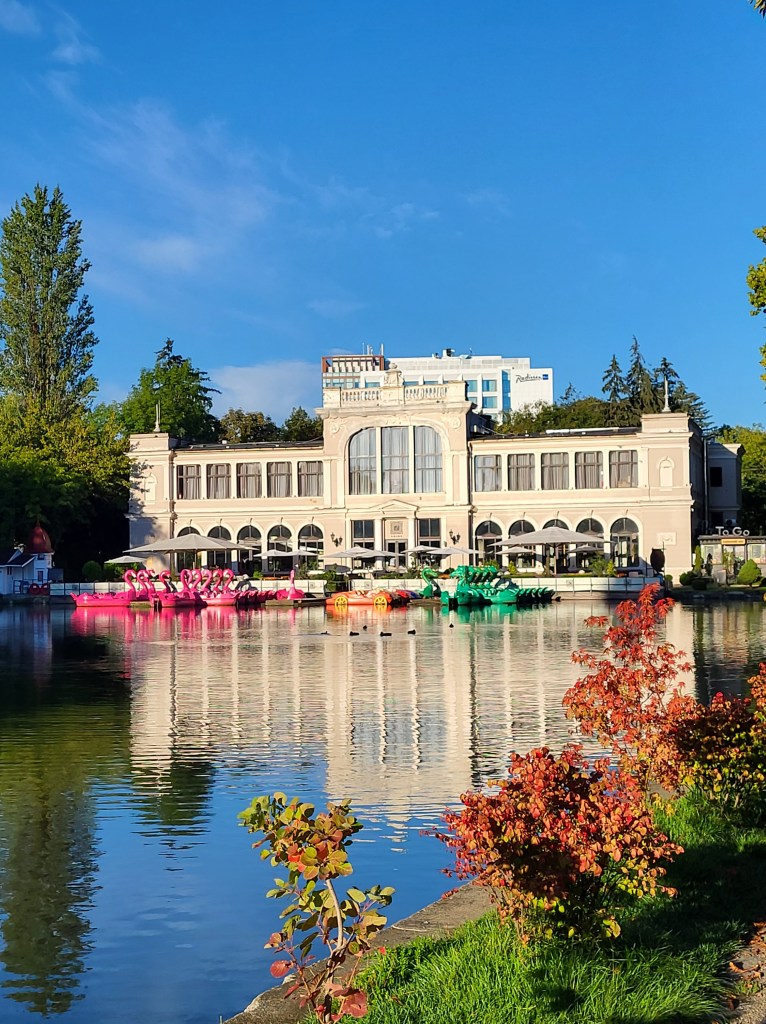
    It’s that run where you stop from time to time, take a photo of a great view, a duck, a lake, whatever sparks joy in you.

    It’s that run that makes you enjoy life again.

    It’s that run when things get quiet in your head.

    It’s that run where the pace doesn’t really matter.

    It’s the run that makes you feel alive.

    ❤️………..🏃

  • Why do I run marathons?

    The legend of the marathon says that an ancient Greek messenger ran from the town of Marathon to Athens, a distance of about 40 kilometers, with the news of an important Greek victory over the Persian army. He barely managed to complete his journey and deliver the message.

    Of course, this is just a legend without proper historical checks, but it brings to light how contemporary life doesn’t bring any physical challenges anymore. Don’t get me wrong, I think it is a great accomplishment. It’s the triumph of human progress, creativity, hard work, and cooperation. But our bodies haven’t evolved into these new times to just sit on a chair for hours without end day after day – and still feel ok and healthy. To counter this, we have created these artificial challenges like the marathon because they feed into the need of the human body to improve, be challenged, and move.

    Marathons remind me that I don’t give up. They are tough and mandate you train a lot more every week, improve and persist. I could enjoy only running half-marathons. Those are really pleasant, easier to train for, and require less mental toughness. But marathons are the ones that get me out of my comfort zone, that make me push myself. Doing hard things creates that self-respect for yourself, that confidence built out of pushing yourself and sticking to your goal through the hardest of moments.

    Marathons are terribly long, but in that lies their beauty. They give you the space to explore yourself. During those 42 km, introspection inevitably pops up. And the same happens in the long runs you need to do in preparation for the race.

    In the end, completing a marathon brings me a lot of joy. And may I dare to say fulfillment.

  • The times I do NOT want to go out for a run.

    Those times are now. I’m looking outside; it rained during the night. It’s cloudy and chilly, just like the inside of me. My mind can only focus on how to keep me distracted long enough to forget about my plan to train today. It’s kind of working. I get caught up in daily things, in other important things I have to do today, and thoughts keep flashing through my mind like a high-speed train passing through an abandoned railroad station. If you want it to be easy, you have to act dumb. Not thinking but just doing gets you out of the building way faster than overthinking.

    Should I reprioritize and postpone my run for another day? Should I wear a warmer jacket or a raincoat? Should I eat? Should I run in that place or another? This death spiral gets to me, and I stop. I take a random shirt and shorts, get dressed, tie my running shoes and go out. It’s done. I’m out and running.

    This was one of my long runs for the marathon I’m participating in, in just 12 days. Maybe it mattered that it was a longer run, maybe it was the weather, maybe it was my mood. But my hack of signing up for a race almost didn’t work, but it eventually did. Would I have gone out to run if I didn’t have the race? I don’t know, but I do know that I really enjoyed my run. It was beautiful. The weather wasn’t, but the ducks on the lake didn’t care, and the falling leaves didn’t care. Nature didn’t care about my struggles. Things were just moving along as they had over and over again. Why was I special? Because I can think and overthink.

  • How I started running – the story of my first half-marathon

    “Luck is when preparation meets opportunity.” I got lucky. In the spring of 2016, a dear friend asked on our messenger group if anybody wanted to participate in the Bucharest Half-Marathon in May that year. He wasn’t a runner; he had never run more than a few kilometers. But he had a free registration from his job, the event looked interesting, so maybe he would do it if others joined.

    I saw that message, and it got me thinking. Me, running? Hmmm…. I do not run. I google what a half-marathon is. 21 kilometers, the f**k! Running 3 km is a struggle. My past comes swirling in. I was the worst runner in my class, from 1st grade to the last. I was the last to finish any endurance race – if I even finished them at all, sometimes I just gave up at some point. So what gives? Back then, I was well on my fitness journey. I have been hitting the gym 5 times a week for the last couple of months. I was in better shape than ever in my life. I was even running on the treadmill as a warm-up for my leg day, doing HIIT training, and I had trimmed a lot of weight.

    It gets interesting. I feel myself getting excited at the prospect of running so many kilometers. It felt like a payback for my childhood years when I was overweight and did not put in the effort to improve. Should I do this? It could be fun; I’m also not doing it alone; I’m in good shape. I signed up. There were just a bit more than 2 months till the race.

    I started reading about how to prepare for a half-marathon. I bought myself some cheap running shoes, and I started training. My first goal: run a 10k. I did that on the treadmill at the gym. I was soaking wet, sipping water constantly, eating some bananas during walking breaks, and seeing the meter go up. I did it, checked, my first ever 10k. It was a really slow run, but the pace didn’t matter. It felt empowering, like a grand achievement, it gave me confidence, and I was hooked.

    I posted my run on social media – that’s how happy I was. People told me running on the road is different; that on the treadmill, it’s easier on the legs. I scheduled my first outdoor runs. That’s how I discovered Herastrau Park with its massive 7km loop. I first did one lap; a few weeks later, I did two laps, and in my longest training run, I did three, totaling 21km. I ran my first half-marathon before my official HM. Again it felt amazing, minus the stiff legs the days after, but even that painful soreness was sweet. It’s a job well done, you push yourself, and your muscles adapt to the new requirements.

    I celebrated my birthday in May by doing my first official HM. I prepped my gear and couldn’t fall asleep the night before – I was so nervous. On the day of the HM, the metro was buzzing with runners, each new station filled with more and more people in shorts and running shirts with numbers. I felt part of something bigger. I met my friend at the start line. We did our warm-up, and the race started. The atmosphere was fantastic, the weather sunny, and friends were cheering for us with placards. We ran together to the finish. There was no doubt we would finish, and we enjoyed the hell out of it. This was the start of something. 

  • What’s it like to run a relay race?

    You zoom in on your phone and check the map. The small circle with a picture inside is moving towards your location. You zoom out of the phone and look into the horizon. A small dot takes the shape of a friend – it’s time. You quickly finish warming up and get ready to race. The silhouette starts to look a lot more like a human. You can see the struggle of the last hundred meters and start cheering. “Come on, let’s go! You’re doing great; you’re almost done.” The movement of the legs stops, and the leg strap with the monitoring chip switches owners. You put it around your leg, congratulate your teammate, and sprint. It’s your race until you cross the finish line or pass the baton forward.

    The relay race is arguably the most exciting run you can do with friends. It’s a social experience; it transforms running from an individual to a team sport. 

    At half-marathons, there’s usually the option to do a 3 x 7 km relay race where each team member runs 7 kilometers to complete the 21km route. This is a fast but also a very accessible one for beginners. At marathons, it’s 4 x 10.5 to total 42 kilometers. The distance is longer but still manageable with enough training. Both versions are fun to do. The first runner begins the race at the starting line, along with the competitors for the half or full marathon. Along the route, there are predefined places where the swap takes place. The last runner of the team is the one that runs to the finish line, where his teammates will greet him victoriously.

    I ran one relay race with two dear friends at the Bucharest International Half-Marathon. We made it a thematic race by dressing up as bunnies. Our team name was “Two and a half bunnies” – it was so much fun.

    If there’s an extraordinarily entertaining way to start running and explore the atmosphere of a race, this is the way. Build your team, signup, practice together and enjoy the run.

  • What’s it like to run a 10k?

    You stand ready for a quick start. 3.. 2..1.. Go! You sprint and make room through the numerous people around you. The pace gets quicker and quicker, and the surroundings move along in a blurry fast carousel. The first-kilometer flies by, and your pulse skyrockets. Your legs warm up as you reach the one and only refreshment point. You don’t need water, so you skip or take a quick sip while slowing down just a bit. Soon enough, you’re closer to the finish than the start, and a quick look at your watch says your pace slowed down but not by much. The outside looks sharper, and you can see the finish.

    A 10k race, 10 kilometers is a fast race. The pros set stunning paces in this one, under 3 minutes per kilometer, which is like a continuous max sprint, just that they keep it up to the finish. For beginners, it can be a challenge to get to the finish line, but it’s more of a mental barrier. Physically, if you train every week and increase your distance ever so slightly but constantly, you’ll have it in your pocket.

    I only raced one 10k, and it was fun. It’s a great race to challenge yourself on time, to grow faster. But it’s also the best distance, to begin with, for people that just started running. Signing up for a 10k while feeling like a lot is the base building block that you can see happening but still fear not being able to pull it off. But again, consistent training works wonders, and you’ll build the confidence to want more.

    From a 10k, you can dare to run a half-marathon and, from there, a marathon. It’s the appetizer of the running buffet. Organizers usually schedule 10k runs on the same day as the longer races, so you get a full taste of the atmosphere, emotion, and joy. Also, the 10k is probably the most popular competition as it attracts the most people.

    Doing a 10k also opens up the option of doing a relay race with friends during a marathon. Usually, there’s the option to run a 10.5 x 4 with 4 people each running 10.5 km to complete the 42 km course. This is a lot of fun and makes running a social experience which usually helps motivate people. The accountability and human factor motivate us more than we sometimes can do on our own.

    My favorite training run is doing a 10k, but for actual races, I do prefer longer distances because it gives me more time to enjoy the experience and feel it to its fullest.

    Running begins with a 10k. Let’s start!

  • What’s it like to run a half-marathon?

    A half-marathon(HM) with its 21 kilometers or 13.1 miles is a considerable challenge and a long run, but at the same time, it’s a manageable one even for beginner runners – with enough training, of course. This was my first race, and it took me around three months of consistent training to run it. 

    In the beginning, a half-marathon can look a lot like a marathon in the sense that there is a tipping point around kilometer 13, where you start feeling your legs tired, lose energy, and start questioning yourself. It’s interesting that, just as in the marathon, it happens when you are a bit over the middle of the distance. From my experience, though, it’s less intense than in the marathon, where it feels like climbing a mountain without a top.

    Half-marathons have enough distance to stretch you while at the same time giving you the time and space to enjoy the moment. It will pass by faster than you expected. After doing a couple dozen, I now find myself at the finish wanting more.

    I love seeing a lot of places during a race, and the HM provides me with the opportunity to experience a variety of views, quiet my mind, get in the flow and enjoy the race. For me, it’s the funniest and most enjoyable race. It’s balanced. A bit challenging but not as much as the marathon. You need consistent training, but you get off with a lot less. 

    If you factor in the time and try to improve your personal best, then things get more challenging. I remember trying to run the HM in under 2 hours, and that one stretched me. You can always find ways to spice things up. A trail HM with an altitude gain is also a different beast. Without proper training, a dirt road uphill HM can be significantly more intense than a marathon – your legs will hit a tall wall.

    The HM is also a great building block to pave the way toward running a marathon. “Divide et impera” – divide and conquer, 2 half-marathons equal one marathon. If you can run a HM, you’re almost halfway towards running the entire 42km. I say “almost” because the 2nd half-marathon has little resemblance to the first one. At the first one, you’re fresh and eager. In the 2nd, you’re running on an imaginary hill going up slowly.

    I would love to inspire more people to run a half-marathon. The distance is not as scary as the marathon, but still highly challenging and immensely gratifying. It builds confidence and makes you wonder what else you can do or run. From my point of view, the HM is the race that unlocks the world of running, and it sure did for me. That’s when I got hooked and wanted to explore more: trail runs, mountain running, marathons, and ultras.

    If this got you dreaming, seize the moment, take action and sign up for a half-marathon. Enjoy the run!

  • What’s it like to run a marathon?

    Do you remember when you had to do a difficult task?
    Something that demanded a lot from you: focus, time, and tons of energy?
    Do you remember going through pain and still continuing your work?
    Do you remember wanting to quit so badly, questioning WHY you are doing this?
    Do you remember that pure joy when you finished that heavy task?
    Do you remember the confidence you had after?
    This is part of what a marathon is like.

    The marathon, with its 42 kilometers or 26 miles, is considered one of the pinnacles of running. And rightly so. It’s a worthy challenge. It will break you but also give you the chance to rebuild yourself, stronger than before. It’s primarily a race with yourself; you’re racing yourself. A part of you crosses the finish line, and some other small parts remain scattered over the route; you shed your doubts like a snake sheds his old skin.

    Signing up for the race is the first step. It will give you the kick to start this journey and maintain course during stormy moments. Visualizing the route, the atmosphere, the people, and that much-desired finish line boosts your spirit to start prepping.

    Training becomes a priority, and longer and stronger runs are needed to sustain the effort. You can’t train the same as for a half-marathon and expect to do just as well in the 2nd part of the race when you went past the known part and went into no man’s land.

    You need a better plan. Training hard but also giving your body enough time to rest, especially on the days before the race. Supplements taken at the right times during the run can help you with the inevitable muscle soreness. My favorite one is magnesium. I wrote here about my detailed experience with it.

    Running a marathon is as much a challenge for your body as it is for your mind. The first 21 km are usually pleasant. You’re not tired, you can maintain a good pace, your leg muscles are warming up, your mind isn’t too busy, and you enjoy the race. The real battle starts in the 2nd part, especially around the 30 mark, from my experience. That’s where your mind will try to trick you; it’s a defense mechanism. It is trying to protect you but doesn’t have a fair estimate of your capabilities. The mind is stopping you early in your tracks; you got a lot more to give. Then you need not listen and find your reason to continue. Focus on that, focus on the next step, the next kilometer, and you’ll reach the finish line.

    It’s estimated that less than 1% of the population ever runs a marathon. You’re in good company; you’re one strong human. Finishing a marathon brings a lot of joy. It builds up your confidence. You’re badass; you ran 42km, that’s astounding.

    Sign up for one and experience it firsthand. It’s totally worth it ❤️

  • Cluj Marathon 2022 – Running in the heart of Transylvania
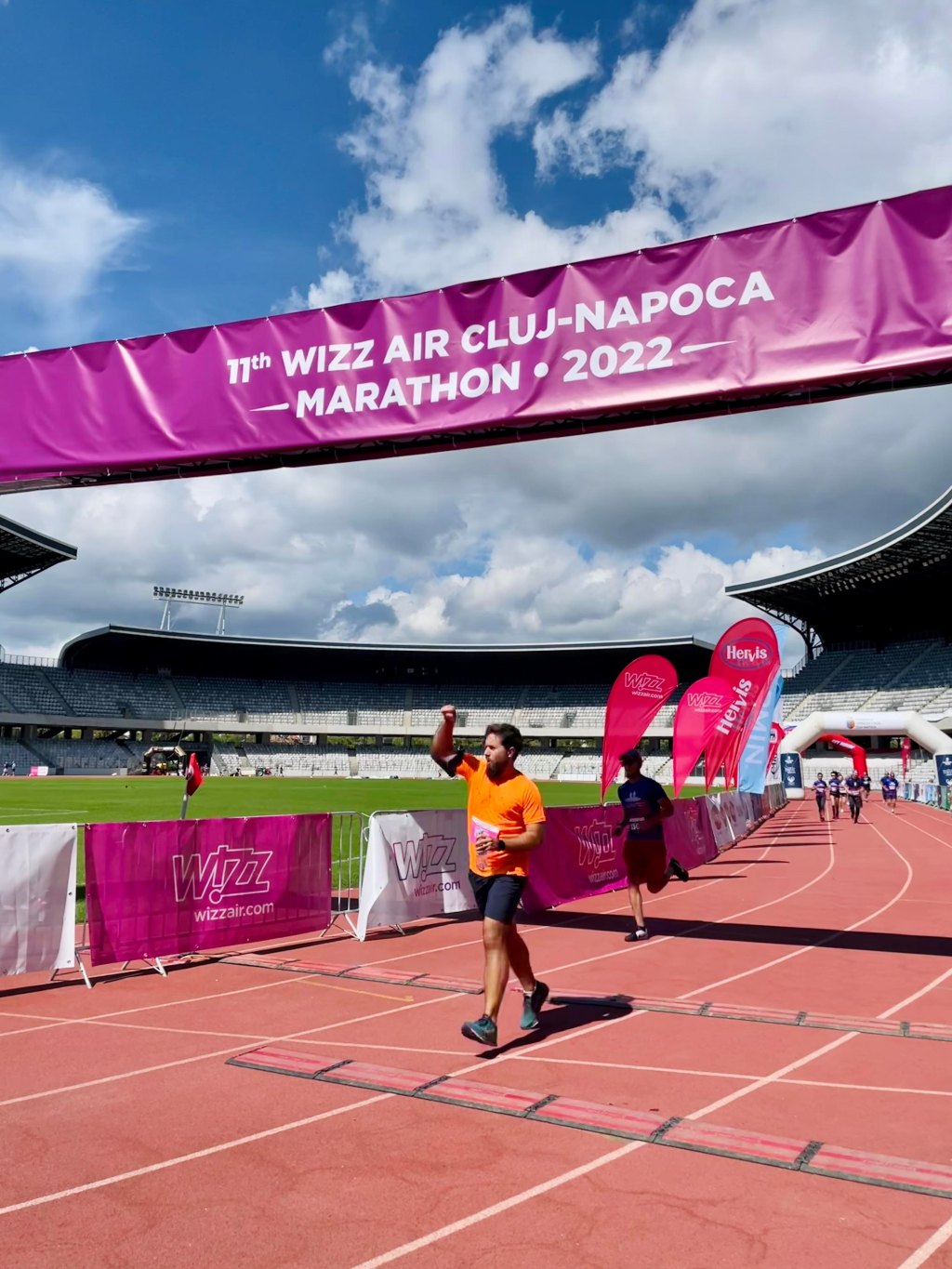
    Cluj Marathon 2022 – Running in the heart of Transylvania

    “One foot in front of another.”
    “Let’s try a bit faster. Let’s try to move faster than walking.”
    “Repeat, endure. We finish this kilometer and get closer to the finish.”
    “Ignore the constant pain of each new step. Don’t listen to your sore legs that yell at you to stop.”
    And then 2 runners just storm by. I recognize one of our national champions. The 10 km race started a few minutes ago, and the first runners are speeding past me as if I’m sitting still.

    My running batteries started to flash at kilometer 25. At 30, they were dead. Even before reaching the 30 mark, I questioned if I could pull this through and in what condition. I would have liked to be able to slowly jog, but walking seemed like the only option my mind would spare me. I started run-walking and then swapped to walk-running. More and more convincing was needed to be able to sustain even a slow running pace for a few hundred meters.

    But where am I? And what am I trying to achieve?
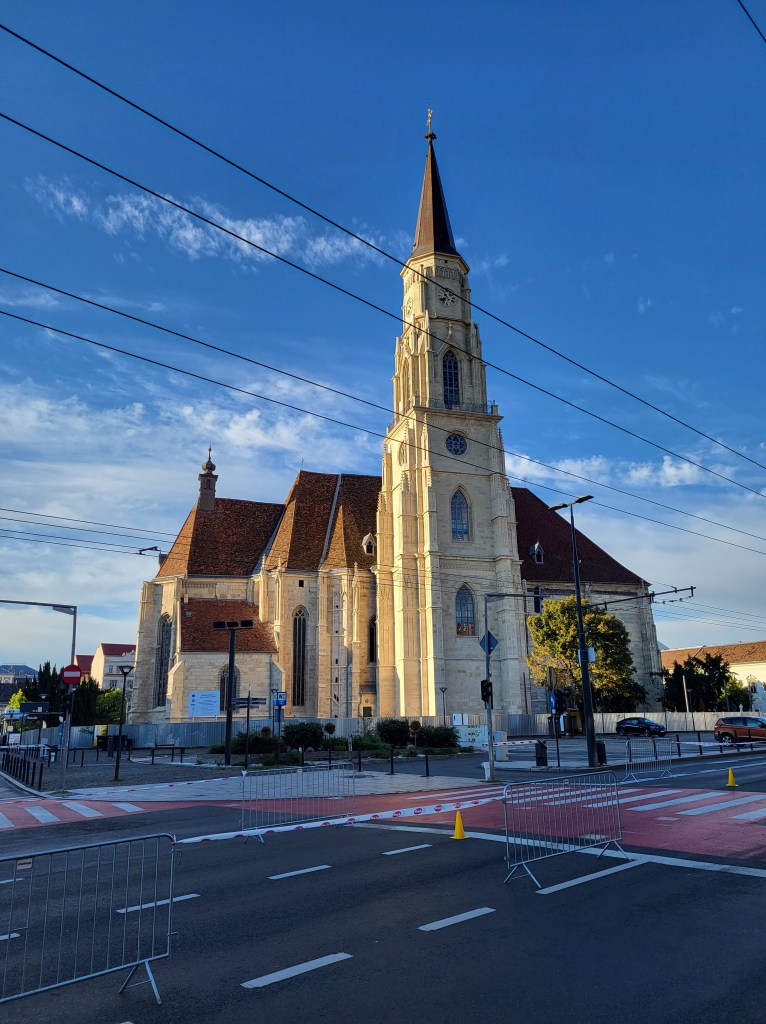
    Roman-Catholic Cathedral in Cluj

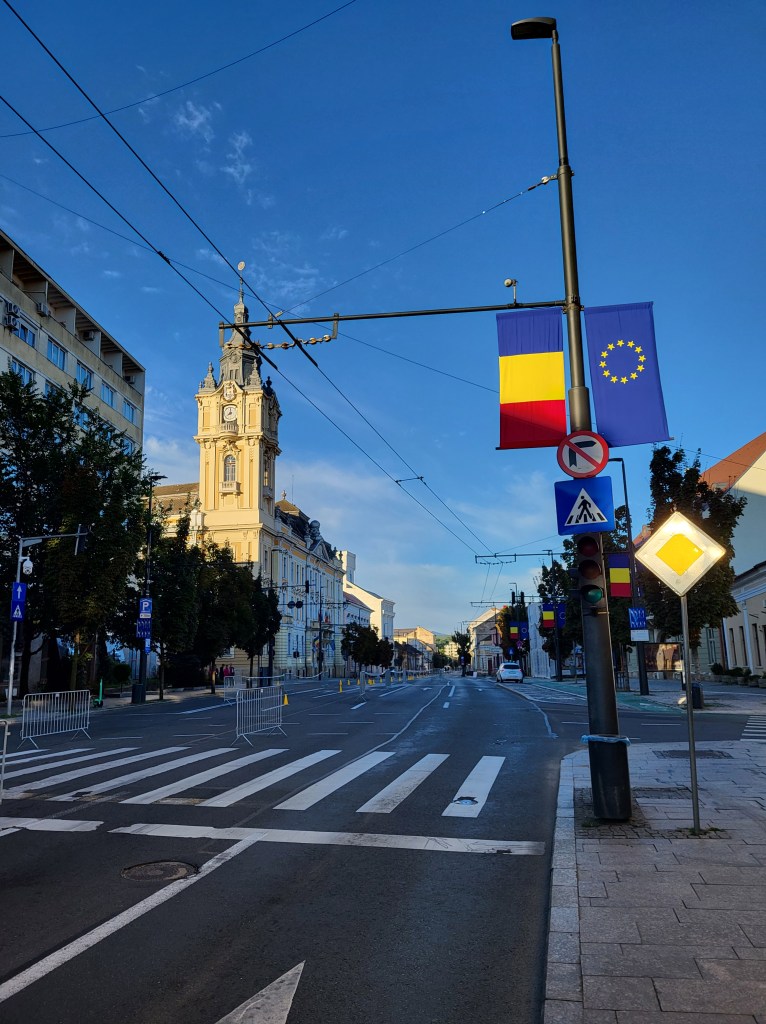
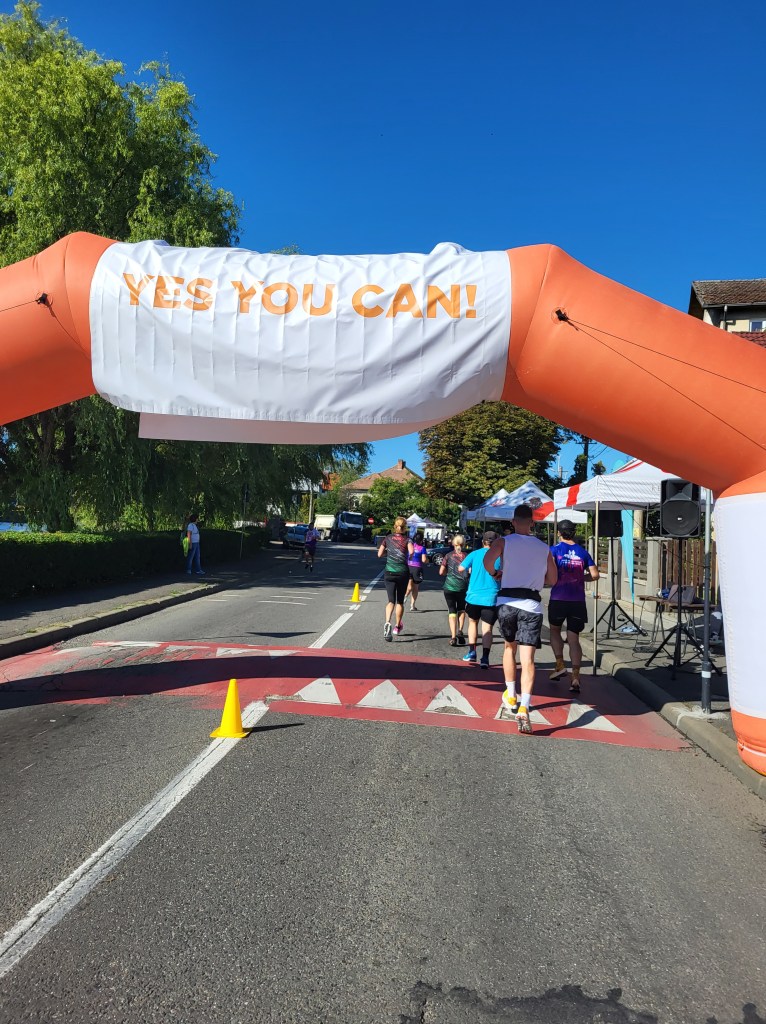
    I’m in Cluj-Napoca – the biggest city in Transylvania, Romania. It’s one lovely day: the perfect temperature for running, a shy sun, empty roads, and a bustling arena. The race starts inside the stadium on the athletic track. The stands are full of runners warming up. I feel like I’m competing in the Olympics, the slow-motion version since I’m twice as slow as the pros.

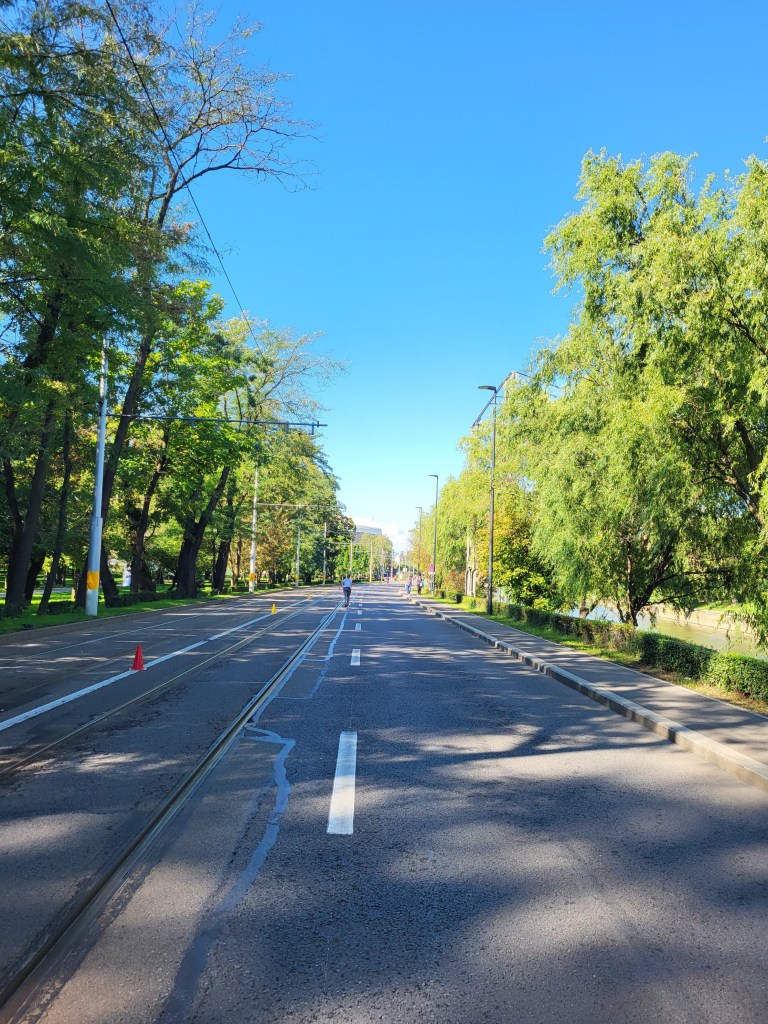
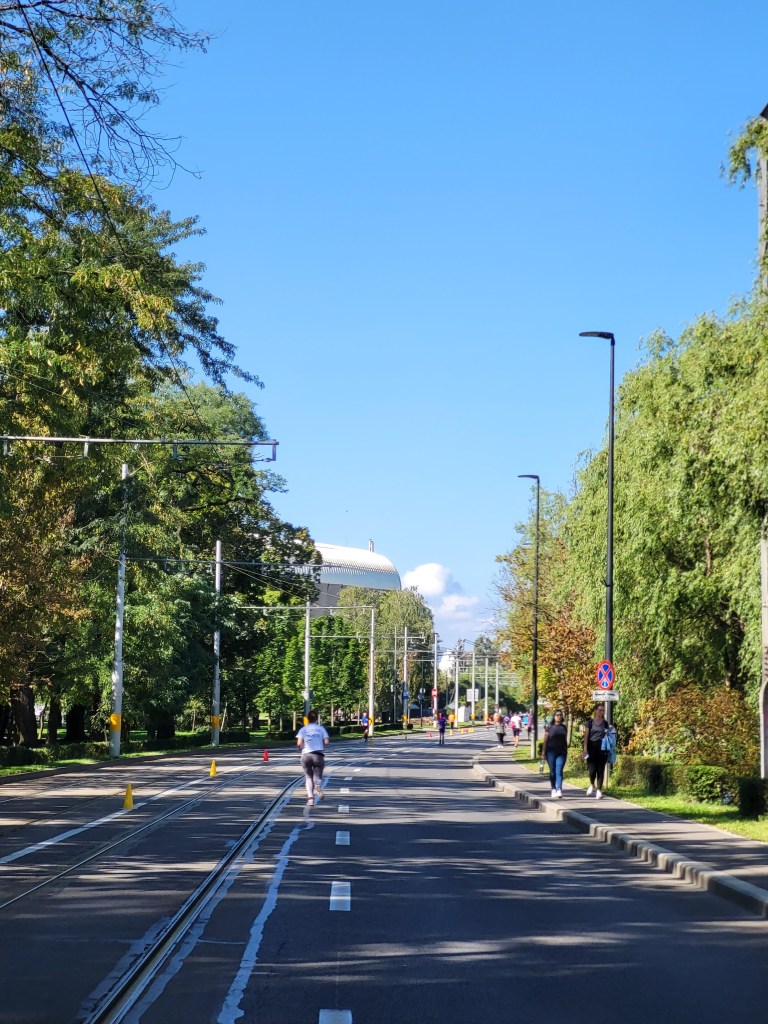
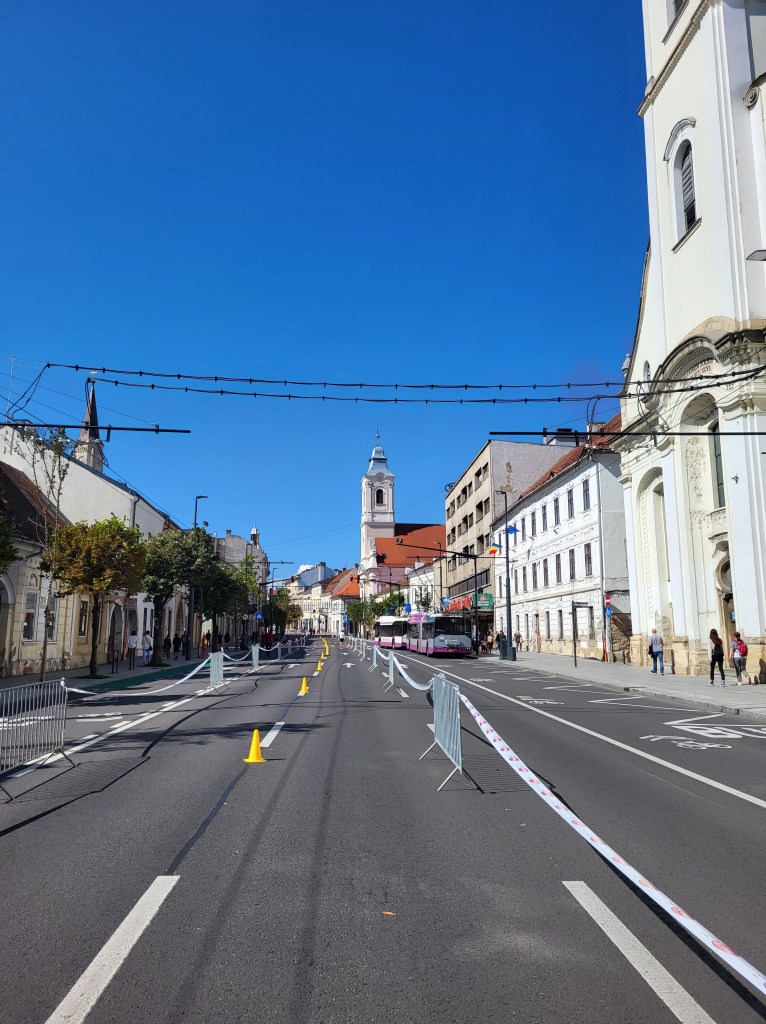
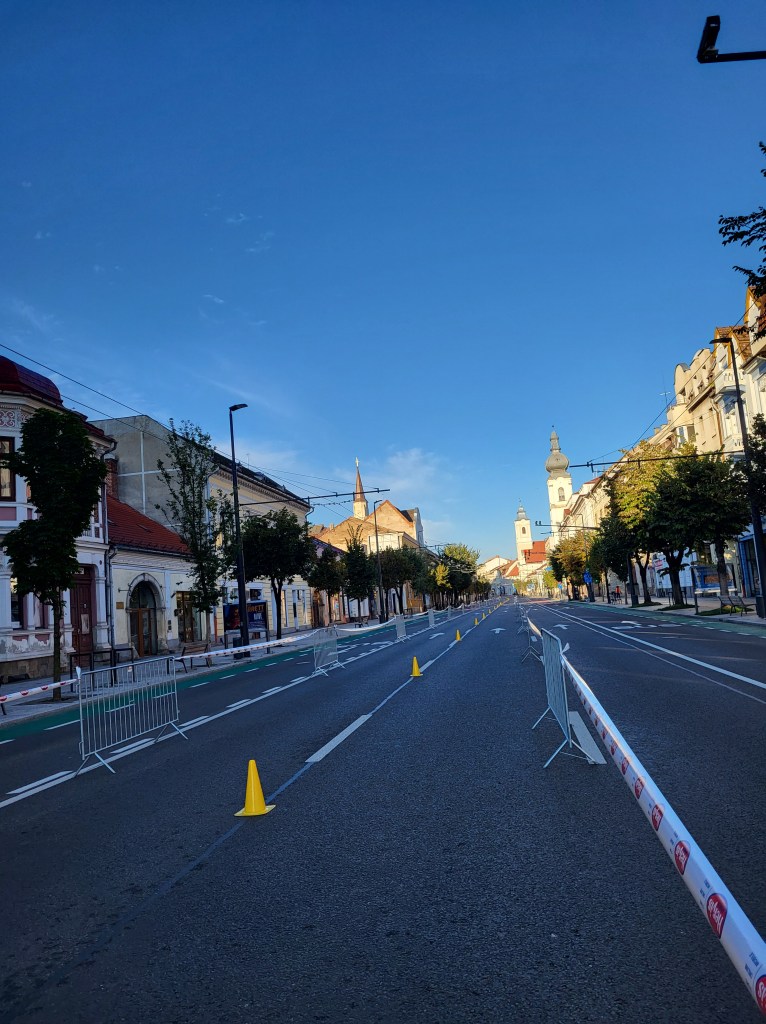
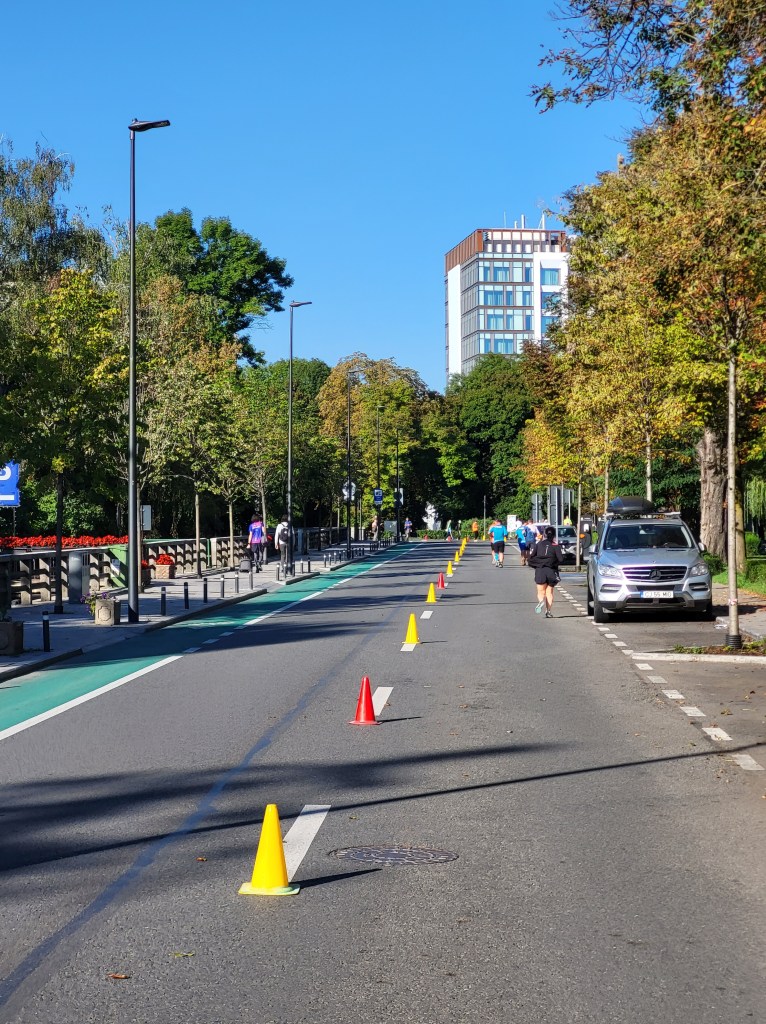
    I’m participating in the marathon race. The route has 2 laps of 21 kilometers each, one for discovery and the second for penitence. In the first lap, I totally enjoyed myself. I maintained a good running pace while taking a few photos and enjoying the empty streets and landmarks.

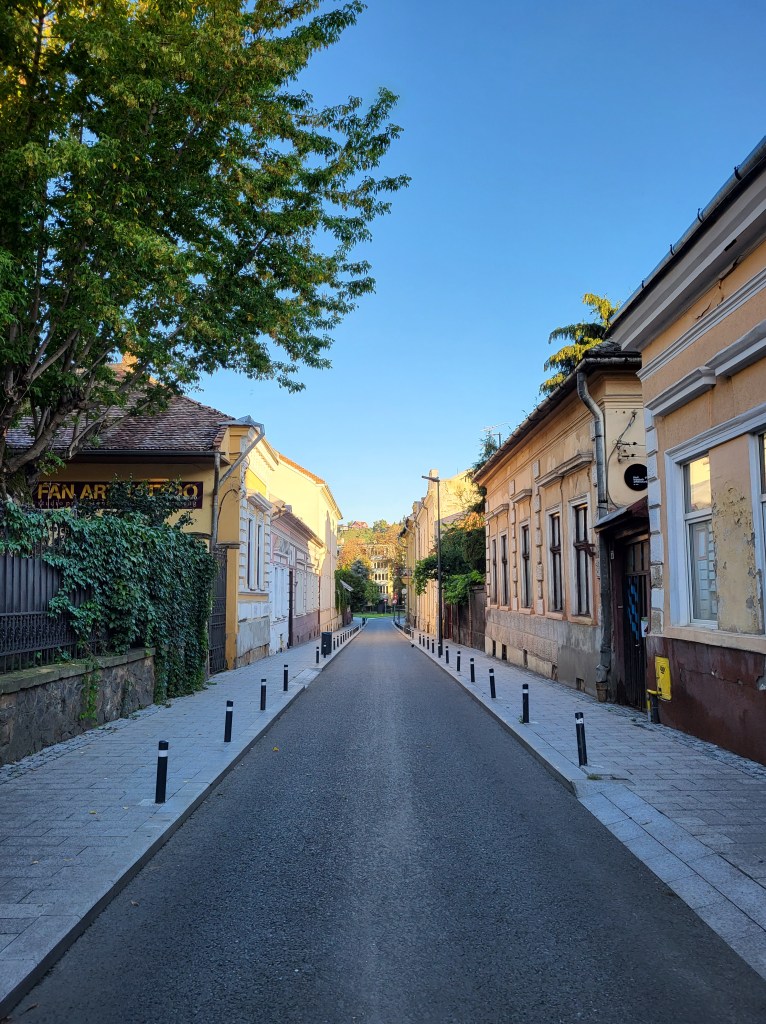
    The route went through the center of Cluj, reaching the Union Plaza revealing the beautiful roman-catholic cathedral. We ran on a narrow street in the city center, around the central park through a lovely old house neighborhood, on the primary alley of the park, along the Somes River, and back to the stadium. A part of me was questioning how I would feel the second time going through these places.

    The answer came, and it wasn’t pretty. The actual race started on the second lap; there began the struggle. I did a lot of run-walking starting at kilometer 25. From the 30 mark, it was more walking than running. I pushed myself to run as much as possible, but my legs were feeling all kinds of compelling pains, the types which you forget exist. I used my entire arsenal of 3 magnesium doses and 2 running gels(one with caffeine), but my legs got heavy and stiff nonetheless.

    The sun became quite bold, and the temperature increased outside and inside my body. I was so thirsty; every checkpoint was heaven. I started feeling like the refreshment points were a great deal further than at the first lap. It took forever to reach the next one. One good move is that at some point, I started taking a bottle of water with me to sip from time to time.

    “Don’t stop when you’re tired; stop when you’re done.” I pushed to get to 32, and after that, I took it one kilometer at a time, praising myself for each newly finished kilometer. It was tough. But in the end gratifying. Running a marathon pushes you out of your comfort zone, or at least mine, but the end result is that you feel amazing. Running past the finish line, you feel so happy and fulfilled. Hours later, you still feel that joy.

    42 kilometers, 26 miles, 55 000 steps to finish my 4th marathon ever and definitely not my last.
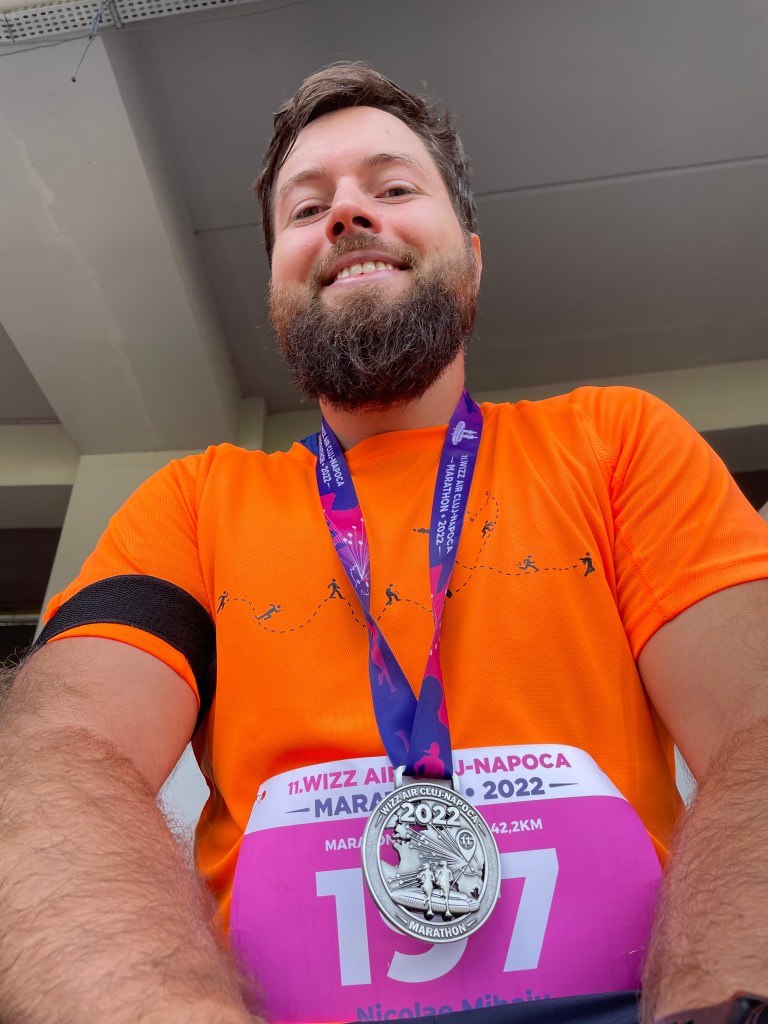
    Me smiling a couple minutes after the finish
  • The build-up toward the race

    The week before

    You can feel a strange feeling growing in your stomach and feet. You do your last training at a slower pace. You have your most intense training days behind you. You’re setting a goal for the race if you haven’t already. You’re rechecking the details of the race; you follow the route and imagine it in your mind. Maybe you use Google Street View to see the real deal. You’re getting close.

    The travel

    It could be that you race in your hometown, but frequently, it’s somewhere else, further or closer. You check the weather and start packing your things. Do you choose a shirt you already have or use the one provided at the race? You take one or two shirts with you just in case. You pack your shorts, running shoes, magnesium, and other supplements. The strange feeling grows – things are getting real.

    The day before

    You’ve arrived at the location – it’s the day before the race. You go pick up your running kit and gaze at the starting line. You get soaked into the atmosphere, the buzz of hundreds of runners, the festivities. You make your way through, tell your name and get your shirt, race number, and bag of goodies. You’re all set up.

    The night before

    You’ve laid out your outfit and gear for tomorrow. Maybe you snatched a photo and posted it on social media. You go to bed early. You probably can’t sleep. You see the race, you’re running it already, you’re there. Good night. 

    That morning

    You wake up early – maybe earlier than you usually do, but you’re energized. You have a mission, and nothing can keep you in bed. You can barely eat anything and get quickly dressed. You go out the door and follow your pre-chosen route to the start. You can feel the chills; it’s not just the morning cold, it’s coming from inside, and you’re both nervous and excited. You start seeing runners going in the same direction, and the streets get flooded with race numbers and colorful shirts – it’s a spectacle. The sound of music increases, and you can hear the MCs speaking – you’re almost there. Next thing you know, you’re standing in line at the start.

    3…2…1… GO! There’s only one thing left to do:

    RUN

  • Running with or after the pacers at races?

    2:00, 2:00, run, run, keep up! I’m breathing heavily, sweating like crazy, taking a mouthful of isotonic, and rapidly getting back on track. I’m trying to run the half-marathon in under 2 hours on a warm spring day. My plan: keep up with the 2:00 pacers and push past them on the last 2 kilometers.

    Major marathon and half-marathon races have these runners with balloons tied to them or with a pole and flag with some numbers. These numbers look like 1:30, 1:45, 2:00, or 2:30 for a half-marathon. That means they will finish the race in 1 hour 30 minutes, 1 hour 45 minutes, or 2 hours. These people are freakin’ awesome. They smile, encourage you, and make you feel part of a tribe. They are volunteers trying to help people reach their goals.

    If you’ve set your mind on running a half-marathon in a specific time, you could run alongside the people with “PACER” written on their shirts. They will for sure guide you to the finish line in your desired time; that’s if you can keep up 🙂
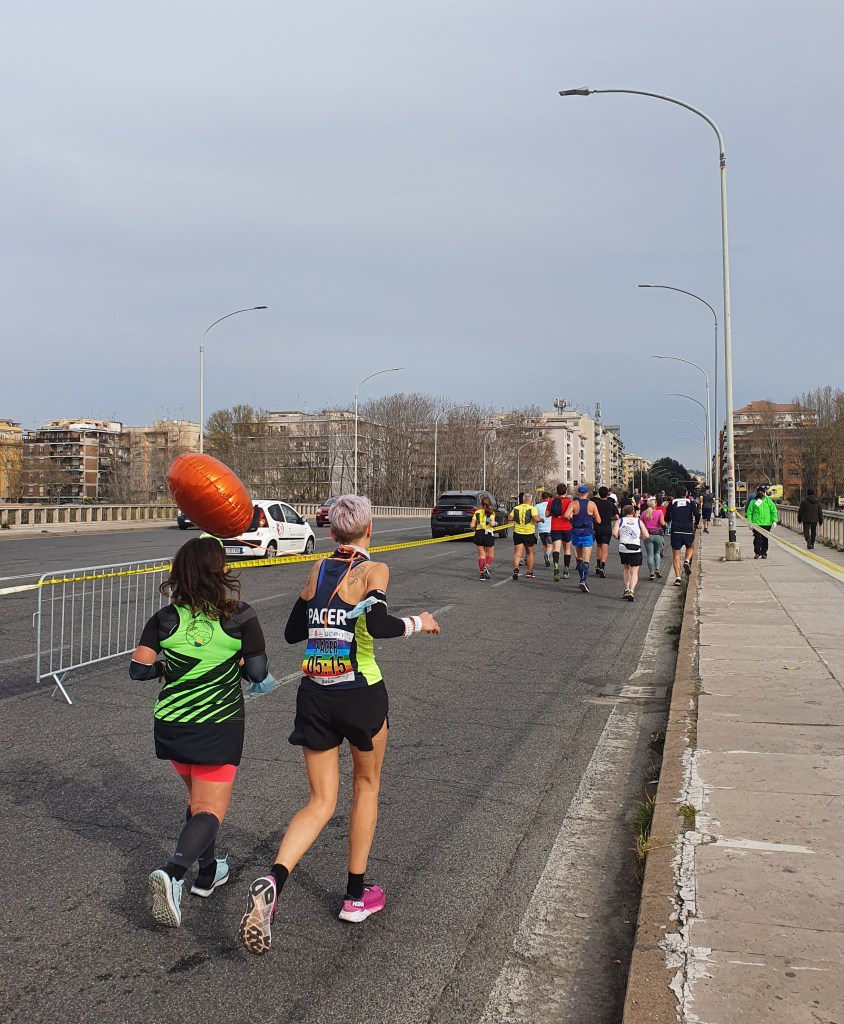
    5:15 Pacer at the Rome Marathon

    Over the last 15 kilometers, I’ve gone from running side by side with the pacers to falling slightly behind; and then increasing the speed to catch up again, and again, and again. From a fun little sprint, I went to a cat and mouse game where I was mostly sitting behind, trying to catch a little moment to speed up and get back in the pack, but that moment was getting farther and farther away.

    The refreshment points were the funniest. If my usual routine was to grab water, drink, and walk a bit to let it settle down, my teammates were not even stopping or, at most, quickly taking a sip and then marching on. Seeing them sprint from the checkpoint made me anxious, so I would drink just a bit of water and then get back on the circuit as fast as possible.

    My eyes are barely seeing the 2:00 sign anymore. Reaching the third refreshment point, I saw the pacers storm away while I was just slowing down to take a sip. That’s when I gave up on the chase. I enjoyed my water, breathed deeply, walked, and enjoyed the crazy mess of runners passing by. We did meet again on a large boulevard where I was on the way down, and they were going up. There were at least 500 meters between us.

    I kept running at a good pace while feeling way more relaxed. I enjoyed the atmosphere, the great weather, the closed roads, and the people cheering for us. Looking at my watch, I calculate that if I keep it up, I’m not far from my goal; I’m bound to finish in close to 2 hours. How close? Well… I finished in 2 hours, 0 minutes, and 50 seconds.

    I did push on the last few kilometers, but it wasn’t enough to finish in under 2 hours. I felt OK with this because I learned so much from this race. My pacer friends had arrived quite some time ago. As I thought, they ran a bit faster than their 2 hours pace. Maybe that slight difference broke me; it was faster than expected.

    All in all, running with or after the pacers is fun and an experience. It helps you push yourself better than you could do on your own, and it gives you a steady pace. In this case, it was a bit too much for me, but it helped me almost hit my goal. I recognized at different races that the pacers will try to keep a constant pace for 99% of the race, slowing just slightly at refreshment points and never actually walking. That’s very different from my style, where I take walking breaks occasionally, especially after drinking water. I also tend to run faster in the beginning and slow down towards the end. They just keep up the same pace like a metronome.

    I also found it helpful to have from time to time pacers in training. It can be a friend or a group that runs at your target pace. Your motivation will increase tenfold, and you will get a clear example of what you have to do. You just have to match their speed and keep along.

    What’s your experience with pacers?

I’m Nick

Welcome to The Slow Run, my cozy corner of the internet dedicated to my love for running. Here, I invite you to join me on a journey of exploring, feeling and of course running. Enjoy! Slowly :)

Let’s connect